When I was fifteen or sixteen, I started collecting postcards. Not to send, and not exactly to keep. To use, eventually, in some future project I couldn’t yet describe. I had a shoebox of them under my bed by the time I was eighteen, and alongside the postcards were photographs I’d taken, pages torn from magazines, and — for reasons that felt important at the time — beer coasters with interesting type or a small illustration in the corner I liked. Each one was a small piece of something I wanted to build. I didn’t know yet what the something was.
I’ve tried to build it twice since then, and failed both times.
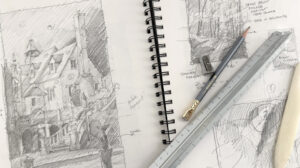
The first attempt was 2009. I was working as an architectural illustrator by then, producing renderings for projects in cities I’d never been to, populated with figures and trees and cars I had to draw one by one for each scene. It was slow work, and a lot of it was the same work done over. A tree I’d painted for one project looked like a tree I could have used on the next. A figure crossing a plaza in Orlando could have crossed a plaza in Shanghai, if I’d only thought to save it. So I started saving. Every illustration I finished, I pulled the reusable pieces into folders — trees, figures, cars, café awnings, street furniture — convinced I was building myself a private reference library that would make the next ten years of work faster and more consistent.
It didn’t quite work. The problem was that the pieces didn’t want to live together. My own style had shifted between projects. The palette I’d used for a 2006 rendering didn’t match the palette I’d used in 2009. The light from one scene fell at the wrong angle for the next. Every time I tried to pull a piece from the folder into a new rendering, I’d end up repainting it to match — and by the time I finished, I might as well have drawn it from scratch. The library of my own work wouldn’t cohere into anything bigger than itself. I put the folders aside and kept drawing.
The second attempt was 2018. By then the iPad had gotten good, and the stylus had gotten better, and I thought maybe the answer was to build the whole thing deliberately. Not pieces harvested from past projects, but a library designed from the start to belong together. One palette, one hand, total coherence. I opened Procreate and started with cars. Then figures. Then trees. I got through maybe a handful of cars, twenty people, thirty trees before I stopped, because the math became impossible to avoid. The library I could see in my head had thousands of pieces in it. The library I could paint, working on evenings and weekends alongside a full career, had dozens. The two numbers weren’t going to meet in any year I could imagine.
I put the iPad aside too.
Looking back, it wasn’t that I couldn’t commit. The impulse was always there, running quietly underneath everything else — the one that started with the shoebox. What I couldn’t do was build the thing I could see. The 2009 version hit a wall I’ll call coherence: even pieces made by my own hand, for different projects, wouldn’t line up into a single world. The 2018 version hit a different wall: scale. One person painting by hand can make a few hundred things in a reasonable amount of time. A library, the kind of library I had in my head, wants thousands. I didn’t have a path from one to the other.
And then, sometime in the middle of 2025, the path appeared.
I’m not going to turn this into an essay about tools — I already wrote one of those, and this isn’t it. What I want to say is narrower. For the first time since I started collecting postcards, I could see a way to build the thing at the scale I wanted, with the coherence I wanted, from one eye. The coherence problem got solved the same way it would have been solved in 1995 if it could have been solved — by making every piece part of a single designed system from the start. The scale problem got solved in a way that wouldn’t have been possible even three years ago. Both walls came down at roughly the same time. I started sketching in June. By November the first collection was out.
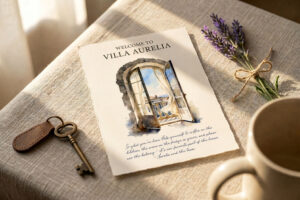
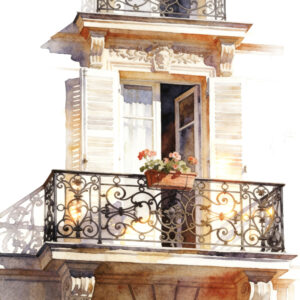
The library is called The Monnaco Collection now, and it’s made of twenty-three collections and roughly sixteen hundred pieces as of this week, with new work going out every Wednesday. The work is watercolor-inspired illustration and film-style photography, organized into themed worlds — a café, a yoga studio, a hotel, a Paris at dawn — each one a chapter in the larger thing. What I’m trying to do with it is what I was trying to do at fifteen with the shoebox, and at thirty with the folders, and at thirty-seven with the iPad. Build a whole world, in pieces, that belongs together.
The only difference is that I can finally make the pieces fast enough to keep up with my eye.
I keep thinking about what I would have done with the shoebox of postcards if someone had told me, at sixteen, that the version of it I was trying to build would take me thirty years to reach. I don’t know if I would have believed them. I don’t know if I would have stayed with it. What I know is that the shoebox was the right instinct, and the 2009 folders were the right instinct, and the iPad sketches were the right instinct — they were just the same instinct in outfits that couldn’t carry what it was reaching for.
This version can. That’s the whole reason I’m building it.