Goethe wrote, in a letter in 1829, that architecture is frozen music. The line has been quoted so many times by so many architects that it can read like a cliché, but I have thought about it for thirty years and I still think he had it exactly right.
I came to it twice. Once as a piano student — ten years of lessons, not good enough for a conservatory, good enough to understand how a piece of music shapes a room. And again as an architecture student, sitting in a lecture hall where someone pointed out that rhythm, proportion, interval, and resolution are words shared by both fields because they describe the same thing in different media. Music moves through time. Architecture is time made to hold still. In both, what the maker is really composing is the experience of the person who will eventually be inside it.
The piano stayed a hobby. Architecture became the work. But the frame — how does this composition feel on the body of a person walking through it — turned out to be the frame I’ve used for everything since.
I remember walking into St. Peter’s for the first time and crying. Then, almost immediately, getting angry about the cost of such a space. Both reactions were the architecture talking. A space that large can only do one thing, which is make you feel how small you are, and the question of whether that was a gift or an injustice has been debated for four hundred years by people more qualified than me. What I remember is that I couldn’t not feel it. The building made sure of that.
I remember Sainte-Chapelle differently. Smaller, and more intimate, and flooded with stained glass — a ceiling of color above you while the street outside was grey. I stood in the middle of it and tried to imagine what it would have felt like to someone in the 1200s, walking in off a muddy road. Most of their world was brown, and wet, and hard. Then they stepped into this. I don’t think there’s a modern experience that compares. We live surrounded by color. They didn’t. The building wasn’t just beautiful — it was a kind of argument, made in light, about what the world could contain if you built carefully enough. That’s what I think architecture can do at its best. Not impress. Propose.
I remember seeing photographs of Tadao Ando’s work in Japan and being struck by how much of the experience came through the image. Ando builds in concrete, quietly, for contemplation. His spaces don’t ask for your attention so much as they arrange the conditions under which attention arrives on its own. What stayed with me was that a photograph of one of those rooms could almost do the same thing. The image wasn’t a record of the building. It was a small version of the building’s intention.
I think about that last one often, because it is the closest thing I have to a theory of what I’m doing now.
The library I am building is not architecture. It is a collection of illustrations and photographs, made at a much smaller scale and with much less at stake than any actual building. But the questions I ask when I make a piece are architectural questions. How does the light fall. Where is the weight of the composition. What is the frame asking the viewer to do with their eyes. What does it feel like, for a second, to be inside this image. I learned those questions by studying architecture, and they still apply.
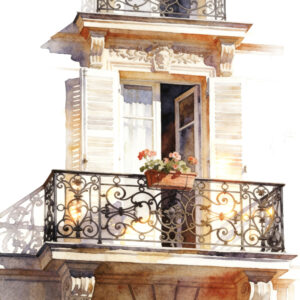
An illustration of a bakery, at the right angle, with the right quality of morning light, is a tiny piece of architecture. So is a photograph of a table being set for dinner. A quiet room in the first hour of the day. A Parisian balcony in soft afternoon light. The library is not trying to document these things. It is trying to stage the small experience of being in them, which is what architecture does at any scale.
Goethe’s line has a second half that most people don’t quote. He wrote it originally in a letter about a cathedral, and what he was describing was the way the stone seemed to him to be vibrating with the music of its own design — as if the architect’s composition hadn’t fully stopped moving. That’s the version of the quote I believe in. Architecture isn’t music frozen still. It’s music held, carefully, for the person standing in the room to hear.
A library of images, done right, can hold a little bit of the same thing.