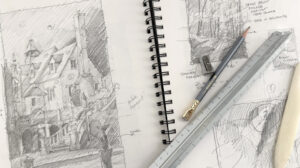
For twenty years, as an architectural illustrator, I worked the same way. I’d start with a rough sketch — my idea, in pencil, the way I wanted the rendering to feel before I knew how it would actually look. Then I’d layer photographs underneath the sketch. A doorway I’d taken a picture of. A cobblestone pattern I needed. A tree with exactly the right canopy. Sometimes dozens of references, stacked beneath my drawing, helping me get the proportions right, to make the light feel believable. Then I’d paint over it all, pulling the sketch back up through the layers until the rendering was what I’d pictured in the first place.
Those layers of photographs were never the source. They were the scaffolding that let me build the thing I already wanted to make. My sketch went in first. My sketch came out last. Everything in between was a way of refining what the sketch was reaching for.
That process won me a prize in 2007. It put me in front of fifty international projects. Nobody ever asked whether the final rendering was drawn from scratch, because that question didn’t really apply. What they were looking at was the finished piece, which is a different thing, and the thing that actually matters.
I mention this because most of what I think about AI in creative work comes back to a book I found as a child.
It was called Entourage — a reference book of small illustrations meant for architects. Trees, people, cars, cafés, awnings, lampposts. Architects used to trace the figures into their own work to turn a blank elevation into something believable. I didn’t know I’d found a professional tool. What I noticed was that someone had drawn a whole world, in pieces, and that the pieces all belonged together. I remember it forty years later. It turned out to be the book I’d spend my career quietly trying to make my own version of.
So the idea that representational art involves borrowed fragments is not new. It’s not even close to new. The camera obscura is from the 1600s — a device that let painters project reality onto canvas and trace it. Vermeer almost certainly used one. Canaletto definitely did. David Hockney wrote a whole book in 2001 arguing that the Old Masters used optical tools far more than the art establishment has ever wanted to admit. The photorealists in the 1970s painted from slides. Illustrators of every century have worked from reference, from photographs, and from each other. The story of the artist alone at a blank canvas, summoning images from nothing, is mostly a myth we tell after the fact. What’s actually happening — and has always been happening — is artists using the tools their moment gives them to see a little more clearly than the generation that came before.
So when people ask me about using AI, honestly, it feels continuous with the work I’ve been doing since I was twenty-two. I start the same way I always have. A sketch in my head of what I want to see. A reference pulled, except now some of those references are generated rather than photographed. A composite. Decisions — lots and lots of decisions — about what to keep and what to throw away and what to rework until it feels right. The collection a reader sees is the result of thousands of those small decisions. The tool changed, but the practice didn’t.
What’s hard about the current moment isn’t the tool itself. It’s the way the word “AI” enters a room and the temperature drops. I’ve watched it happen in DMs, in panels, in a comment section at seven in the morning when I probably shouldn’t have been reading comments. The rhetoric has been loud enough for long enough that people react to the word before they’ve looked at the work. I get it. The last few years have been a lot. But the reaction is about the word. It’s not about the image.
Nobody stood in front of a Vermeer and said “yes, but the camera obscura did this.” They stood in front of it and they believed the light on the wall.
That’s what I want. I want the work to be looked at. I want the light on the wall to feel right. Whether I got there with a pencil or a projector or a generative base layer, the light is what’s on the page, and the light is what the person looking at it responds to. The tool I used to see it is the least interesting thing in the room.
The book I found as a child was already dated by the time I got to it. The drawings were unmistakably of their decade, a little stiff. What made them worth keeping wasn’t the technique. It was that somebody had sat down long enough to draw a whole world.
That’s still the thing that matters.